

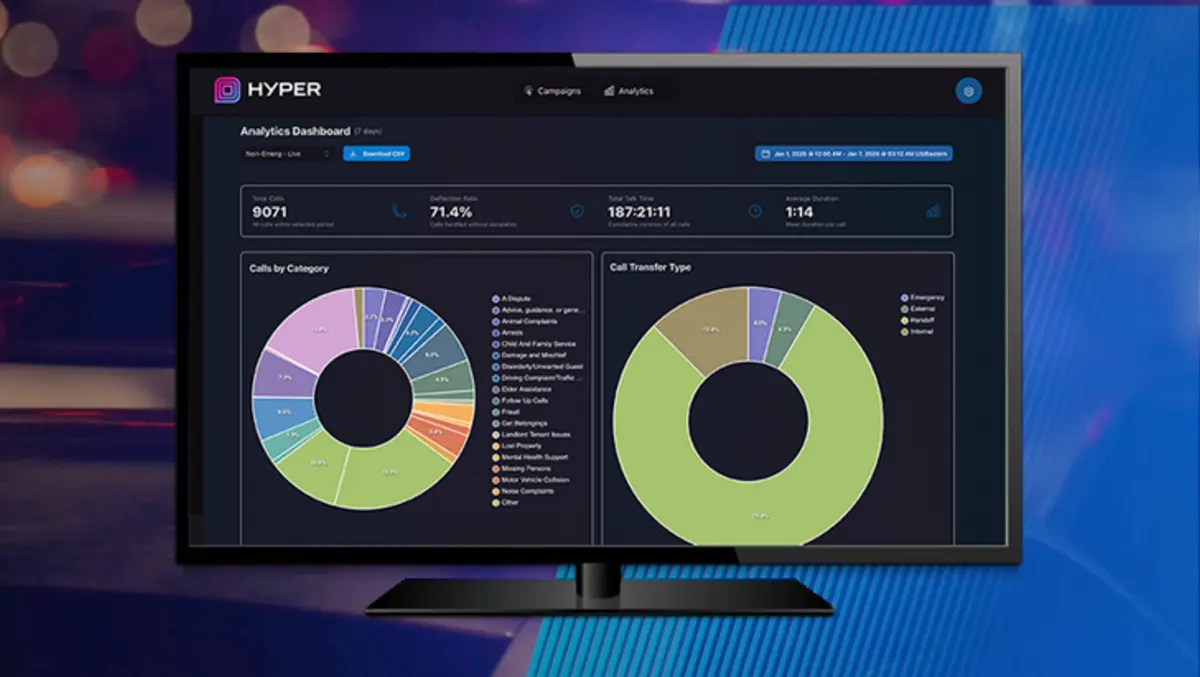

Motorola Solutions has acquired Canadian-founded Hyper, adding conversational AI for non-emergency public safety calls to its portfolio.
Hyper's technology will become part of Motorola Solutions' Command Centre business and its Assist artificial intelligence offering for public safety agencies. Terms of the transaction were not disclosed.
Hyper develops conversational, agentic AI for public safety answering points, or PSAPs, which handle emergency and non-emergency calls. The technology is intended to ease pressure on call handlers and dispatchers by automating parts of the workflow for non-emergency calls.
Staffing shortages remain a persistent issue for many U.S. call centres. Industry figures cited by Motorola Solutions show many PSAPs operate at about 75 per cent staffing, while non-emergency calls can account for more than two-thirds of overall call volumes.
That imbalance has made call triage and handling a key focus for automation vendors serving emergency communications agencies. The challenge is to reduce routine workload without missing cases that escalate into emergencies.
Hyper's system is designed to handle non-emergency interactions autonomously and recognise when a situation changes. Motorola Solutions gave the example of a vehicle breakdown that escalates into a multi-car collision, at which point the call would be redirected to a 911 specialist.
The acquisition also expands Motorola Solutions' use of AI across public safety workflows beyond radio traffic and incident data. The company plans to introduce additional Assist Agents that can interpret the context of 911 calls, radio communications and other inputs to trigger emergency actions under set conditions.
Those agents are intended to translate between callers and call handlers in real time, guide staff through complex emergency scenarios and support resource dispatch. The system also includes controls for human supervision, with autonomous actions limited to pre-set agency parameters.
That emphasis on oversight reflects a wider debate in emergency services over AI's role in frontline operations. Public safety agencies have been testing automation tools for call-taking, transcription and dispatch support, but many insist that human judgment must remain central in high-risk incidents.
Ashish Kakkad, Chief Information Officer at the San Diego County Sheriff's Office, described how the technology has been used in practice.
"By automating the routing of non-emergency calls, our telecommunicators can focus more of their time on emergency situations that require judgment, empathy and critical thinking. It's a practical use of technology that improves outcomes for our community," Kakkad said.
The deal gives Motorola Solutions another specialist asset in a market where software companies are seeking a larger role in emergency response operations. The group already sells communications equipment, command centre software and related systems to police, fire and ambulance services, making AI-based call handling a logical extension of its public safety business.
Ben Sanders, Chief Executive Officer and Co-Founder of Hyper, framed the deal as part of a broader shift in emergency communications technology. "We built Hyper around a simple, non-negotiable truth: when someone calls for help, there can't be a delay," Sanders said. "We're proud to join Motorola Solutions in leading this new wave of agentic AI for the 911 workflow - technology that can move as fast as the crisis at the other end of the call."